We may earn a commission when you buy through links on this page. Listings and prices come from our partners and change often. Learn more.
Vintage cocktail glasses fall into a handful of working shapes: the coupe (champagne saucer), the Nick and Nora, the V-shaped martini or cocktail glass, the tall highball and Collins, the short old fashioned or rocks glass, the champagne flute and the small cordial. Difford’s Guide says three or four shapes cover most drinks.
This hub explains each shape, how to tell them apart, and what makes a vintage set worth buying. It also links to our guides on colored glass, mid-century designers and crystal makers.
What to check in any vintage glass set
Before the shape, check the set. A good vintage purchase usually passes these tests:
- Complete and matching. A set of six or eight identical glasses is easier to use and to resell than a mixed group.
- Clean rims and feet. Run a finger around each rim for nicks, and check stems for hairline cracks where they meet the bowl.
- Decoration intact. Gold bands, silver overlay and enamel can wear, especially at the rim where lips touch. Look for thinning or gaps.
- Clear glass. Waterford notes that dishwasher heat, friction and detergent can dull or scratch crystal, so haze that does not wipe clean is a warning sign.
- A named maker or designer, if claimed. A signature, acid mark or paper label should match the maker’s known work.
Capacity also matters more than many buyers expect. Wikipedia’s entry on the cocktail glass notes that older cocktail glasses were typically around 4 oz, far smaller than many modern ones.
Coupe glasses (champagne saucers)
The coupe is a wide, shallow bowl on a stem. Difford’s Guide notes that it is also known as the champagne saucer and calls it perfect for straight-up drinks, with a typical capacity of about 7 oz (20 cl).
Its history is older than the cocktail. Apollo Magazine traces breast-shaped drinking cups back to Greek mastos cups of the 4th century BC and treats the story that the coupe was modeled on Madame de Pompadour or Marie Antoinette as legend. The wide bowl let bubbles escape, which suited drinkers who did not prize fizz. By the late 1930s, tastes had shifted toward more effervescence, and the flute took over for champagne.
That shift is good news for collectors: coupes made for champagne in the first half of the 20th century now serve daiquiris, sidecars and gimlets. Etched and cut crystal coupes are among the most decorative vintage glasses you can find.
Vintage coupe glasses
Browse current vintage coupe glasses on eBay, pre-owned pieces, from $50.
Shop vintage coupe glassesOpens eBay in a new tab. Check condition, seller feedback and returns on the listing.
What is the name for the martini glass?
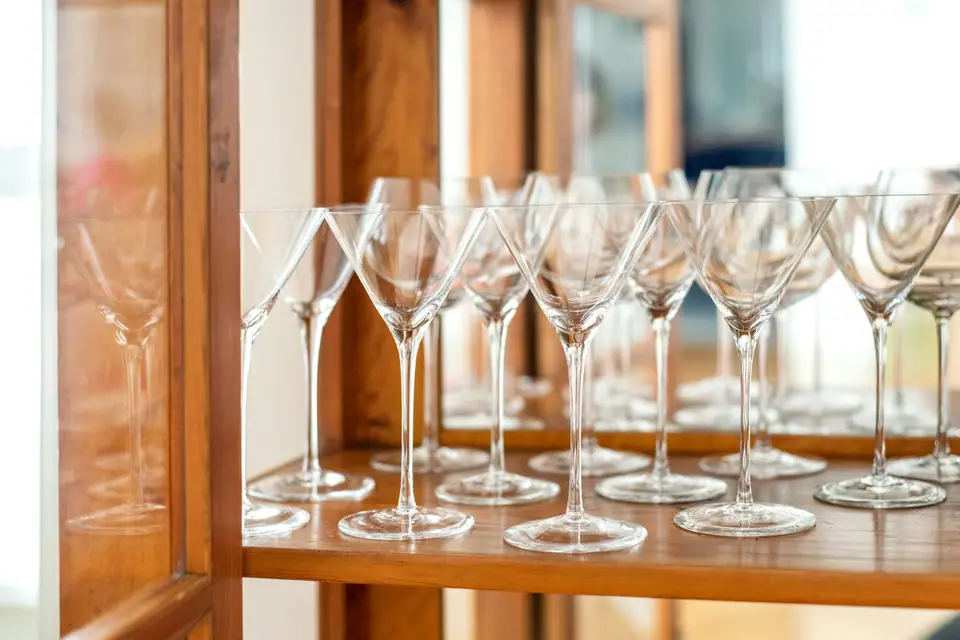
The glass most people picture for a martini is formally a cocktail glass: a stemmed glass with an inverted cone bowl. Wikipedia’s entry on the cocktail glass notes that “martini glass” is the common alternative name, and that the stem lets you hold the drink without warming it.
The same entry says standard cocktail glasses range from about 3 to 10 US fl oz, and that older examples were typically around 4 oz. Difford’s Guide puts the maximum at about 7 oz and argues that a martini somehow is not a martini in a rounded glass. The wide V has lost some ground because it spills easily, which is one reason coupes and Nick and Noras returned.
For vintage buyers, size is a useful clue. VinePair notes that large conical glasses dominated bars in the 1980s, so a very large, wide V is less likely to be early.
Vintage martini glasses
Browse current vintage martini glasses on eBay, pre-owned pieces, from $50.
Shop vintage martini glassesOpens eBay in a new tab. Check condition, seller feedback and returns on the listing.
Nick and Nora glasses
The Nick and Nora is a small stemmed glass with a tall, rounded bowl and a narrow mouth. VinePair describes it as having a long stem, high-sided bowl and a modest capacity of about five ounces; Difford’s Guide gives 4 to 6 oz.
The name is recent, even though the shape is not. According to VinePair, bartender Dale DeGroff found the glass as the “Little Martini” in a 1930s catalog from Minners Designs while sourcing glassware for the reopened Rainbow Room in New York in 1987. He called it the Nick and Nora, after the detective couple in Dashiell Hammett’s 1934 novel “The Thin Man” and the films that followed, and the manufacturer later adopted his name.
For collectors this means one thing: a genuine 1930s or 1940s glass of this shape will rarely be sold as a “Nick and Nora” in period literature. Sellers use the term to describe the shape. Small stemmed glasses listed as cocktail, cordial or “little martini” glasses can be the same form.
Vintage Nick and Nora glasses
Browse current vintage Nick and Nora glasses on eBay, pre-owned pieces, from $50.
Shop vintage Nick and Nora glassesOpens eBay in a new tab. Check condition, seller feedback and returns on the listing.
Highball and Collins glasses
Both are tall tumblers for drinks with ice and a mixer, but they are not quite the same. Difford’s Guide describes the Collins as a catch-all term for tall, slim, straight-sided glasses of about 12 to 14 oz. The highball is slightly squatter, broader and smaller, at about 6 to 10 oz, and Difford’s suggests 8 oz as the most useful size.
Mid-century American highballs are where decorated barware shines. Culver, for example, was founded in Brooklyn in 1939 and by the late 1950s had developed its own way of applying gold to the outside of its glasses, according to The Joy of Cocktails. Our guide to Culver barware covers its patterns and marks, and mid-century barware designers compares Culver with Georges Briard, Dorothy Thorpe and Fred Press.
Vintage highball and Collins glasses
Browse current vintage highball glasses on eBay, pre-owned pieces, from $50.
Shop vintage highball glassesOpens eBay in a new tab. Check condition, seller feedback and returns on the listing.
Old fashioned, rocks and roly poly glasses
The old fashioned glass is a short tumbler with a wide brim and a thick base, strong enough for muddling. Wikipedia lists rocks glass, whiskey glass and lowball as other names, with a standard size of 6 to 10 US fl oz. The larger double old fashioned, or DOF, holds 12 to 16 US fl oz.
Difford’s Guide treats the rocks glass as a sturdier, more utilitarian old fashioned, often with thicker glass and rim. “Roly poly” usually refers to a rounded short tumbler. Dorothy Thorpe’s silver-banded Roly Poly tumblers, according to 1stDibs, became a staple of the mid-century home bar.
Heavy cut crystal tumblers from the great European houses also fall in this family. Baccarat’s Harcourt line, designed in 1841, includes glasses and decanters and remains in production, so condition and marks matter when you buy an older piece. See how to identify Baccarat crystal for the marks by period.
Vintage old fashioned and rocks glasses
Browse current vintage old fashioned glasses on eBay, pre-owned pieces, from $50.
Shop vintage old fashioned glassesOpens eBay in a new tab. Check condition, seller feedback and returns on the listing.
Flutes and cordials
The champagne flute is tall and narrow. Difford’s Guide puts it at about 6 oz and recommends it for champagne cocktails because the slim shape holds the bubbles. Apollo Magazine notes that the flute became the preferred champagne glass by the late 1930s.
Cordial glasses are the smallest stemmed glasses in a vintage bar set, made for liqueurs and after-dinner sips. They can turn up alongside decanters in matching sets, so check that the count and pattern match the listing. If you collect decanters, our guide to collecting vintage crystal decanters explains how to judge stoppers, marks and completeness.
Colored, gilded and designer glasses
Glass color changes both the look and the market. Cobalt, ruby, amber and uranium glass each have their own collectors, and gold-banded glasses need gentler care than plain ones. Our guide to vintage colored glassware explains what gives each color its tint, why uranium glass glows under UV light, and what actually drives value.
| Shape | Typical size (sources above) | Served | Also sold as |
|---|---|---|---|
| Coupe | About 7 oz | Up, no ice | Champagne saucer |
| Martini / cocktail | About 3 to 10 oz | Up, no ice | Cocktail glass |
| Nick and Nora | About 4 to 6 oz | Up, no ice | Little martini |
| Highball | About 6 to 10 oz | Tall, with ice | Hi-ball |
| Collins | About 12 to 14 oz | Tall, with ice | Tall tumbler |
| Old fashioned | 6 to 10 oz (DOF 12 to 16) | Short, with ice | Rocks, lowball |
| Flute | About 6 oz | Sparkling | Champagne flute |
How to buy vintage glasses safely
Ask for photos of every glass in a set, held against light, plus close views of the rims and any marks. A set photographed as a group can hide one chipped glass. Check whether the listing counts glasses or pieces, since a “set” can include a pitcher or ice bucket.
Our guide to buying vintage barware on eBay safely covers questions to ask, seller feedback and what to do if a glass arrives broken. If you are mixing drinks in your vintage glasses, vintage cocktail shakers explains cobbler, Boston and Parisian styles.
Guides in this series
- Vintage colored glassware: cobalt, ruby, amber, uranium and gold rim.
- Mid-century barware designers: Culver, Georges Briard, Dorothy Thorpe and Fred Press.
- Culver barware: 22k gold patterns, marks and value.
- Vintage cocktail shakers: shaker styles and what collectors look for.
- Collecting vintage crystal decanters: the decanter hub.
- How to identify genuine Baccarat crystal: marks by period.
Questions collectors ask
How many types of bar glasses are there?
No standards body fixes the number, so lists range from a handful to several dozen depending on how finely they split shapes and sizes. For cocktails, about eight shapes do most of the work: coupe, Nick and Nora, martini, highball, Collins, old fashioned or rocks, flute and cordial.
What is the name for the glass used to serve martinis?
It is usually called a cocktail glass or martini glass: a stemmed glass with an inverted cone bowl. Many bars now serve martinis in a coupe or a Nick and Nora instead, since the wide V shape spills easily.
What are the best barware glasses to start with?
Difford's Guide says a set of Collins, coupe and old fashioned or rocks glasses, plus flutes for champagne cocktails, will serve most drinks. For vintage buyers, a matching set in good condition is easier to use than a mixed group of singles.
What is another word for drinkware?
Common alternatives are glassware, barware and stemware. Stemware means glasses with a stem, such as coupes and flutes, while barware also covers tools like shakers, jiggers and ice buckets.
What is the difference between a coupe and a Nick and Nora?
Both are stemmed glasses for drinks served without ice. The coupe has a wide, shallow bowl of about 7 oz, while the Nick and Nora has a smaller, taller bowl with a narrower mouth that spills less.
Sources
- Cocktail Glassware Guide: Chilling, Types and SizesDifford's Guide
- How the Nick & Nora Became the Most Famous Glass of the Cocktail RevivalVinePair
- The titillating origins of the champagne coupeApollo Magazine
- Cocktail glassWikipedia
- Old fashioned glassWikipedia
- Dorothy Thorpe: designer biography1stDibs
- Culver Glass CompanyThe Joy of Cocktails
- Care GuideWaterford
- Harcourt CollectionBaccarat