We may earn a commission when you buy through links on this page. Listings and prices come from our partners and change often. How we make money.
A vintage punch bowl set is a wide bowl with matching cups and a ladle, sometimes on a stand or underplate. Pressed glass sets are the practical choice, cut crystal bowls are heavier and brighter, and silver plate suits a formal table. Count the cups, check the scalloped rim for chips, and use lead crystal for serving only.
Punch bowls come out for the same few weeks every year: Thanksgiving, Friendsgiving, Christmas and New Year. This guide explains the types, names the makers and patterns we could source, and covers what to check before buying. It sits under our hub on vintage cocktail glasses.
What is a punch bowl, and where did it come from?
Wikipedia defines a punch bowl as a bowl, often large and wide, for serving mixed drinks with a ladle. Its entry on punch says the word is commonly said to come from the Hindi for “five”, after the five ingredients of the original drink, and that employees of the East India Company brought punch to England in the 17th century.
Early bowls were usually ceramic or silver. A related form, the monteith, has a scalloped edge and appeared in Britain around 1680. By 1832, one writer quoted by Wikipedia called the punch bowl “an indispensable vessel in every house above the humblest class.”
Punch does not have to contain alcohol. The same entry describes non-alcoholic punch as a mix of fruit juice, water and a sweetener, often with ginger ale or soda. A vintage bowl serves cider, lemonade or sparkling fruit punch just as well.
Pressed glass, cut crystal, silver plate or milk glass?
| Type | How it is made | What to expect |
|---|---|---|
| Pressed glass | Molten glass pressed into a mold with a plunger | The everyday vintage set: bowl, cups and often a stand |
| Cut crystal | Leaded glass cut against wheels, then polished | Heavy, bright and sharp to the touch; often a bowl alone or on a stand |
| Silver plate | A plated metal bowl, sometimes with a tray and cups | Marks on the base tell plate from sterling |
| Milk glass or ceramic | Opaque white glass or pottery with lettering | Tom and Jerry sets with mugs |
Pressed glass punch sets
Pressed glass made the punch set affordable. Wikipedia’s entry credits John P. Bakewell of Pittsburgh with patenting machine pressing in 1825, and says that between 1850 and 1910 most inexpensive mass-produced glassware was pressed.
One pattern name you may see on punch set listings is Fostoria’s American. The Fostoria Glass Company was founded in Fostoria, Ohio, in December 1887 and moved to Moundsville, West Virginia, in 1891. It introduced American, pattern number 2056, in 1915, and its Moundsville plant closed in 1986. That long run means pieces from different decades can be mixed in one set, so compare the cups closely.
We name only patterns we can source. If a listing gives a pattern name you do not recognize, ask the seller where the attribution comes from.
Cut crystal punch bowls
The American Cut Glass Association dates the Brilliant period from about 1876 until World War I. It explains that glass made for cutting contains up to 40 percent lead oxide, which makes it soft enough to cut against moving wheels without shattering.
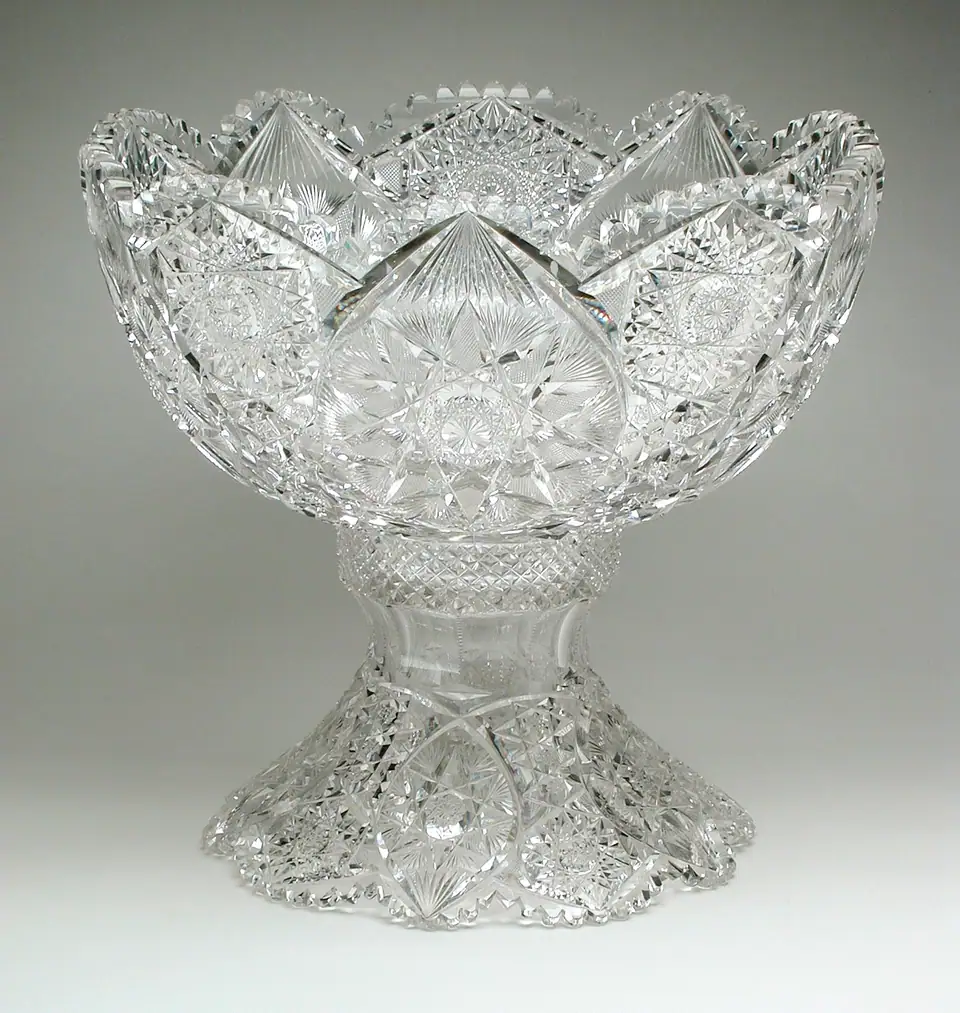
Museum examples show the scale. The Metropolitan Museum of Art holds a blown and cut glass punch bowl by C. Dorflinger and Sons, dated 1890 to 1905, that measures 14 3/4 by 14 1/8 inches. The Los Angeles County Museum of Art has a cut glass bowl on a matching stand by the Meriden Cut Glass Company, shown at the top of this page.
The Association lists three signs of cut leaded crystal:
- A bell-like ring when gently tapped with a finger.
- Clarity and brilliance that pressed or molded glass does not match.
- Weight noticeably greater than a piece of the same size in unleaded glass.
You cannot tap a bowl in a listing, so ask the seller for the weight and a close photo of the cutting.
Vintage punch bowl sets with cups
Shop the range
Browse current vintage punch bowl sets on eBay, pre-owned pieces, from $40.
Shop vintage punch bowl setsOpens eBay in a new tab. Check condition, seller feedback and returns on the listing.
Silver and silver plate punch bowls
Silver is one of the oldest materials for a punch bowl, and many vintage bowls sold as silver are plate, not sterling. The Birmingham Assay Office lists EPNS, EPBM and “Silver Plate” among the marks found on plated items. Our guide to sterling vs silver plate hallmarks explains how to read the base before you pay a sterling price.
A plated ice bucket beside the bowl keeps ice separate, so the punch is not watered down as the evening goes on.
Vintage silver-plate ice buckets for the punch table
Shop the range
Browse current vintage silver ice buckets on eBay, pre-owned pieces, from $75.
Shop vintage silver ice bucketsOpens eBay in a new tab. Check condition, seller feedback and returns on the listing.
Tom and Jerry sets
A Tom and Jerry set is a bowl with matching mugs, lettered with the name of a hot, egg-based holiday drink. Wikipedia calls the Tom and Jerry a traditional Christmastime drink in the United States, sometimes attributed to the British writer Pierce Egan in the 1820s. PUNCH magazine places its origin in the early 1800s and notes that the story crediting bartender Jerry Thomas has been debunked.
For collectors, the sets matter more than the argument. PUNCH describes bowls in ceramic, porcelain and milk glass, often lettered in an Old English typeface, some in gold. It reports that the oldest bowl its writer found dates to between 1880 and 1890, and that milk glass versions were widely made in the 1940s by Hazel-Atlas, Anchor Hocking and McKee.
Check that the lettering on every mug matches the bowl, and ask about wear to any gold.
What should you check before buying a vintage punch bowl?
- The rim. Scalloped and sawtooth rims chip easily. Ask for a photo of the whole rim from above.
- The cup count. Cup counts vary from set to set. Match the number in the title to the photos.
- Hooks and ladle. If the set hangs its cups from the rim, count the hooks. Ask whether the ladle is glass, plated metal or a later plastic replacement.
- The stand or underplate. Some stands are separate pieces that can also be missing. Ask whether the bowl sits steady.
- Size and capacity. Ask for the diameter, height and the capacity as the maker or seller states it. Measure your table and your storage shelf.
- Packing. A bowl this size needs double boxing, and every cup should be wrapped on its own.
Our guide to buying vintage barware on eBay safely covers seller feedback and what to do if a piece arrives damaged.
Is it safe to serve punch in a lead crystal bowl?
Treat a cut crystal bowl as serving ware. Health Canada advises limiting lead crystalware to serving food or drinks, never storing them. It adds that more lead may transfer to highly acidic foods or drinks such as fruit juices, soft drinks or wine, and that the risk rises the longer they sit.
Fruit punch is acidic, so timing matters. A Montana county health department, Lewis and Clark Public Health, advises not storing drinks in lead crystal for more than a few hours. In practice:
- Fill the bowl shortly before guests arrive.
- Empty and wash it when the party ends. Do not refrigerate leftovers in it.
- Use a pressed glass or other lead-free bowl for a children’s table. Health Canada says lead-free tableware is especially important when serving infants, children or pregnant people.
Safety
Using a punch bowl for Thanksgiving and Friendsgiving
A punch bowl lets guests serve themselves, which takes one job off the host during a meal that already has many. Set it away from the kitchen, on a sideboard or bar cart, with the cups on a tray beside it. Our guide to a mid-century home bar setup has a checklist for a self-serve drinks station.
A bowl of cider or sparkling fruit punch gives every guest something to hold, including those who do not drink alcohol. The same bowl works through December for Christmas parties and New Year’s Eve.
For the table itself, see holiday table glassware, which covers water goblets and wine glasses for each place.
How do you clean and store a punch bowl?
Wash by hand. Waterford’s care guide says dishwasher heat, friction and detergent can dull or scratch the surface of crystal, and warns that extreme temperatures can crack it, so never pour a hot liquid into a cold bowl. Dry with a lint-free cloth and store the cups rims up.
Our guide to caring for vintage glassware covers cloudy glass and gold decoration. If the set is a present for someone who entertains, vintage host gifts has smaller ideas that are easier to carry to the door.
Questions collectors ask
What comes in a vintage punch bowl set?
A full set has the bowl, matching cups and a ladle. Some add a stand or an underplate, and some pressed glass sets have hooks that hang the cups from the rim. Listings vary, so count every piece against the photos.
How can I tell a cut glass punch bowl from a pressed glass one?
The American Cut Glass Association gives three signs of cut leaded crystal: a bell-like ring when gently tapped, clarity and brilliance that pressed or molded glass does not match, and noticeably greater weight than unleaded glass of the same size.
Can I serve punch in a lead crystal punch bowl?
Health Canada advises using lead crystalware for serving only, never storing, and notes that acidic drinks such as fruit juices, soft drinks or wine pick up more lead. Fill the bowl just before guests arrive and empty it when the party ends.
What is a Tom and Jerry punch bowl set?
It is a bowl with matching mugs lettered Tom and Jerry, made for a hot holiday drink of the same name. PUNCH magazine describes ceramic, porcelain and milk glass sets, with milk glass versions widely made in the 1940s by firms including Hazel-Atlas, Anchor Hocking and McKee.
How big is a punch bowl?
Sizes vary widely. A cut glass bowl by C. Dorflinger and Sons in the Metropolitan Museum of Art measures 14 3/4 by 14 1/8 inches. For a bowl you plan to use, ask the seller for the diameter, height and stated capacity.
Are punch cups and the bowl always the same pattern?
Not always. Cups break and get replaced, so a set can mix patterns that look alike in a group photo. Ask for a close photo of one cup beside the bowl.
Sources
- Punch bowlWikipedia
- Punch (drink)Wikipedia
- Pressed glassWikipedia
- What is American Brilliant Cut Glass?American Cut Glass Association
- Punch bowl, C. Dorflinger and Sons, 1890 to 1905The Metropolitan Museum of Art
- Punch Bowl on Stand, Meriden Cut Glass Company (LACMA M.91.320.6)Los Angeles County Museum of Art, via Wikimedia Commons
- Fostoria Glass CompanyWikipedia
- About Those Tom and Jerry BowlsPUNCH
- Tom and Jerry (drink)Wikipedia
- Silver Assay and Hallmarking ExplainedBirmingham Assay Office
- Lead crystalware and your healthHealth Canada
- Is it safe to use lead crystalware?Lewis and Clark Public Health, Lead Education and Assistance Program
- Care GuideWaterford
From our guide to Vintage Cocktail Glasses: Coupes, Nick and Nora, Martini and Rocks.