We may earn a commission when you buy through links on this page. Listings and prices come from our partners and change often. Learn more.
Wash vintage crystal and glass by hand in lukewarm to warm water with a little mild soap, rinse well and dry with a lint-free cloth. Keep it out of the dishwasher, avoid sudden temperature changes, and store glasses rim up with space between them. Gold rims need extra care: no dishwasher, no scrubbing, and no lemon detergents.
The advice below comes from the makers themselves (Waterford, Baccarat, Lenox and Libbey) and from museum conservators at the Corning Museum of Glass and the Canadian Conservation Institute. Where makers disagree, the more cautious advice suits vintage pieces.
How do you wash vintage crystal by hand?
The makers’ routines are close to identical:
- Line the sink. The Canadian Conservation Institute suggests a basin lined with a towel or soft mat.
- Use lukewarm or warm water. Waterford says warm soapy water; the Canadian Conservation Institute says lukewarm, with a drop of liquid dish soap for sturdy pieces in sound condition.
- Wash one piece at a time. Waterford advises washing pieces separately and warns against twisting the bowl in the opposite direction to the stem.
- Skip abrasives. Waterford rules out harsh or abrasive cleaners. Lenox warns that aggressive cleaners, including lemon detergents, can leave crystal hazy or cloudy over time.
- Rinse and dry. Rinse thoroughly and dry with a clean, soft, lint-free cloth.
Handle with clean bare hands. The Canadian Conservation Institute advises against gloves, which can be slippery.
Why keep vintage glass out of the dishwasher?
Three separate kinds of source agree on this:
- Makers. Waterford says dishwasher heat, friction and detergent can dull or scratch the surface. Baccarat’s US guidance recommends hand washing with warm water or a mild soap to avoid damage.
- Conservators. The Canadian Conservation Institute says fine glass should not go through dishwashers because detergents are extremely harsh.
- Museum scientists. The Corning Museum of Glass calls dishwashers one of the worst environments for glass, pointing to heat and humidity cycling and the alkaline conditions inside.
Newer crystal can be tougher. Waterford says its new lead-free crystal withstands 150 dishwasher cycles, yet it still recommends hand washing. That claim covers new lead-free production, not vintage lead crystal.
Why is my vintage glass cloudy?
Cloudiness has at least three causes, and only some can be fixed.
| Cause | What it looks like | Can it be removed? | Source |
|---|---|---|---|
| Mineral film | White film from hard water drying on the glass | Usually, with a vinegar soak and gentle scrubbing | Libbey |
| Etching | Permanent haze; rainbow tints of blue, purple, pink or brown when tilted in light | No | Libbey |
| Deterioration (crizzling) | Cloudy, milky or iridescent surface; in later stages, fine cracks | Do not try; consult a conservator | Corning Museum of Glass, Canadian Conservation Institute |
Film and deposits
Libbey, the glass manufacturer, explains that filming comes from hard water minerals drying on the surface, and that it can be reversed with vinegar. For haze on its crystal, Baccarat suggests pouring a few handfuls of coarse salt and half a liter of spirit vinegar into the glass, shaking vigorously, then rinsing several times in lukewarm water. For old pieces, Baccarat recommends coarse salt and white vinegar.
Etching
Etching is damage, not dirt. Libbey describes it as permanent eroding or pitting of the glass surface, says natural or softened soft water is most often to blame, and says there is no practical way to restore the luster. Because film responds to vinegar and etching does not, a vinegar soak that changes nothing points to etching.
Glass deterioration
Old glass can decay from within. The Corning Museum of Glass describes crizzling, or “glass disease,” as atmospheric deterioration: alkali leaches out of the glass and gives the surface a cloudy or hazy look. It progresses in stages, from a haze that can be washed off to fine cracks and, eventually, fragmentation.
The Canadian Conservation Institute is direct about this. Iridescence, cloudiness or milky coloring on the surface are signs the glass has deteriorated, and it should not be cleaned. It adds that glass which is weeping or crizzling should be kept in closed containers with humidity as constant as possible.
Knowing which kind of clouding a piece has is also a buying skill. Our guide to telling if vintage glassware is valuable covers condition and value together.
How do you clean gold-rimmed and decorated glass?
Gold decoration sits on the surface of the glass, so it takes the brunt of washing and handling. Lenox, which makes gold- and platinum-banded drinkware, gives the clearest guidance:
- Always wash by hand.
- Wipe a discolored band with a mix of half water and half vinegar.
- Do not use lemon detergents.
The Canadian Conservation Institute adds two cautions. Before washing a decorated piece, make sure painted or gilded designs are not coming off and are not soluble in water. Take care with cloths too, which can snag on rough surfaces or loosely attached decoration.
These rules apply to mid-century gold barware such as Culver’s 22k gold glasses and to gilded pieces covered in our guide to vintage colored glassware. Waterford’s guidance for its color-coated pieces follows the same pattern: hand wash separately, no bleach, no solvents and no dishwasher.
How do you clean and use a crystal decanter?
- Stains. Baccarat advises a soft cloth and soapy water at room temperature.
- Haze inside. Baccarat’s coarse salt and spirit vinegar method suits decanters, since you can shake it inside.
- Before first use. Waterford suggests filling a decanter with a 50/50 vinegar and water solution and leaving it overnight. Health Canada advises soaking new lead crystalware in vinegar for 24 hours and rinsing it thoroughly.
- Ongoing. Waterford says to change the contents often to avoid film build-up.
On lead crystal specifically, Health Canada advises using it only for serving, never storing, and only from time to time. It also recommends hand washing in warm water with a mild detergent and a soft cloth or sponge. Our guide on whether it is safe to store spirits in a lead crystal decanter covers that guidance in full.
Vintage crystal decanters listed now
Browse current vintage crystal decanters on eBay, pre-owned pieces, from $100.
Shop vintage crystal decantersOpens eBay in a new tab. Check condition, seller feedback and returns on the listing.
How should you store vintage glassware?
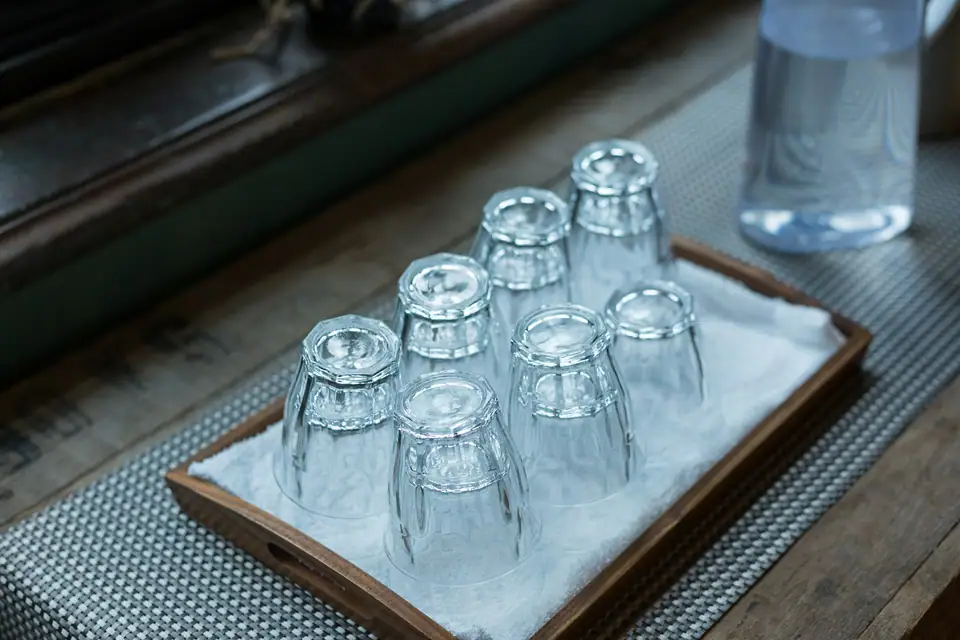
- Rims up. Waterford says rims are the most fragile part and should never be turned upside down for drying or storing. Lenox says the lip can crack and chip over time from the weight of the bowl and stem.
- Leave space. Lenox advises air space around each piece, since glass expands in heat and could touch its neighbor.
- Pad shelves and stacks. The Canadian Conservation Institute suggests lining shelves with soft, non-fibrous padding such as polyethylene foam, and a cushion of soft material between stacked pieces.
- Watch humidity for fragile old glass. The Corning Museum of Glass links very low and very high humidity (below 40 percent or above 55 percent relative humidity) to faster crizzling.
What cleaning methods should you avoid?
- Bleach and acids. The Canadian Conservation Institute says not to try bleach or acid on stains that washing will not remove.
- Abrasives and scouring pads. Waterford and Lenox both rule them out.
- The microwave or oven. Waterford says not to use its crystal in either.
- Cleaning deteriorated glass. Leave cloudy, iridescent or flaking old glass to a conservator.
Related guides
This guide sits within our guide to collecting vintage crystal decanters. For patterns you can still buy new, which may tolerate more washing, see crystal patterns still in production.
Questions collectors ask
Can you put vintage crystal in the dishwasher?
Makers advise against it. Waterford says dishwasher heat, friction and detergent can dull or scratch crystal, and Baccarat's US guidance recommends hand washing. The Corning Museum of Glass calls dishwashers one of the worst environments for glass.
How do I get cloudy vintage glass clear again?
It depends on the cause. A mineral film from hard water can come off with vinegar, and Baccarat suggests coarse salt and spirit vinegar for haze. Etching from dishwashers is permanent, and a cloudy or iridescent surface on old glass can be deterioration that conservators say should not be cleaned.
How do you clean gold-rimmed glasses?
By hand. Lenox says to always hand wash gold- or platinum-banded drinkware, to wipe a discolored band with half water and half vinegar, and to avoid lemon detergents, which it describes as more aggressive.
Should crystal glasses be stored upside down?
No. Waterford says rims are the most fragile part of a glass and should never be turned upside down for drying or storing. Lenox adds that the lip can crack and chip over time under the weight of the bowl and stem.
How do I clean the inside of a crystal decanter?
Baccarat suggests coarse salt and spirit vinegar shaken inside, then several rinses in lukewarm water. Waterford suggests a 50/50 vinegar and water solution left overnight before first use, and changing contents often to avoid film build-up.
Is it safe to soak lead crystal in vinegar?
Health Canada actually advises soaking new lead crystalware in vinegar for 24 hours and rinsing it before use. It also advises using lead crystal only for serving, never for storing food or drinks.
Sources
- Care GuideWaterford
- Can I wash Baccarat crystal glasses in my dishwasher?Baccarat
- What can I do when my glasses have become white / opaque?Baccarat
- How can I remove the color stain from a decanter or glass?Baccarat
- How can I clean an old Baccarat piece?Baccarat
- Lenox Brands Product Use and CareLenox
- Care and Handling: Restoring shine to cloudy or etched glasswareLibbey
- What causes an oily film on glass objects?Corning Museum of Glass
- Basic care: Glass and ceramic objectsCanadian Conservation Institute
- Care of Ceramics and Glass (CCI Notes 5/1)Canadian Conservation Institute
- Lead crystalware and your healthHealth Canada
From our guide to Collecting Vintage Crystal Decanters: A Buyer's Guide.