We may earn a commission when you buy through links on this page. Listings and prices come from our partners and change often. Learn more.
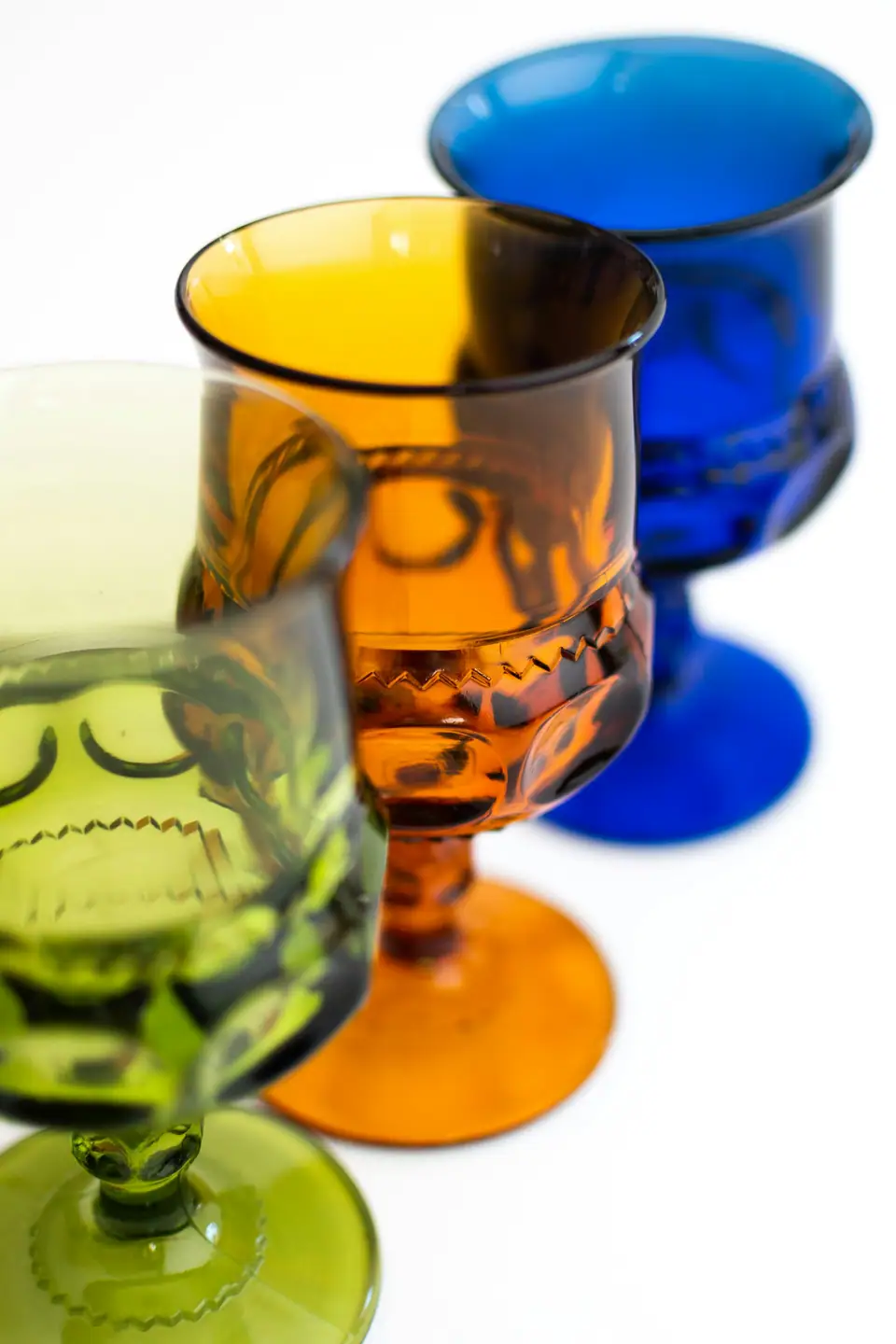
Vintage colored glassware covers cobalt blue, ruby and cranberry red, amber, green and jadeite, Depression pink, uranium (Vaseline) glass and gold-banded barware. No single color is always the most expensive. Value depends on rarity within a maker’s range, condition and demand: gold ruby was costly to make, while amber Depression glass was so common it rarely commands much.
This guide takes each color in turn. It sits under our hub on vintage cocktail glasses, which covers the shapes.
What gives vintage glass its color?
The Corning Museum of Glass explains that one way to color glass is to dissolve a metallic oxide in the batch, which tints the glass all the way through. Different metals give different results:
| Colorant (Corning Museum of Glass) | Color |
|---|---|
| Cobalt | Very dark blue |
| Copper | Light blue |
| Iron | Greens |
| Iron and sulfur | Ambers and browns |
| Manganese | Shades of amethyst |
| Tin | White |
| Various metals | Reddish glass |
Gold ruby and cranberry glass are colored with gold, and uranium glass with uranium. Both are covered below.
Cobalt blue glass
Cobalt gives the deep, saturated blue that collectors call cobalt. The Corning Museum of Glass lists it as the colorant for very dark blue, while copper gives lighter blues, so a pale blue glass is usually not cobalt.
In Depression glass, Wikipedia’s overview lists cobalt blue among the less common colors, alongside ruby red and uranium glass. That scarcity is part of why blue versions of popular patterns attract collectors. Invaluable notes that blue Mayfair pieces can be worth several hundred dollars, while the pink version of the same pattern remains common.
For barware, check cobalt glasses for scratches and for wear on any silver or gold decoration.
Vintage cobalt blue glassware
Browse current vintage cobalt blue glassware on eBay, pre-owned pieces, from $25.
Shop vintage cobalt blue glasswareOpens eBay in a new tab. Check condition, seller feedback and returns on the listing.
Ruby and cranberry red glass
Red is the color with the most interesting chemistry. The Glass Encyclopedia describes gold ruby glass as red glass made by adding gold chloride, a solution produced by dissolving gold metal in aqua regia, to the glass batch. It calls the process both difficult and expensive. Cranberry glass is the lighter pink version, made with less gold.
The same source notes that later cranberry pieces often use a thin cranberry layer over clear glass to reduce cost. If a red glass looks clear where it is chipped or at the foot, it may be cased (layered) rather than colored through.
Not all red glass uses gold. The Corning Museum of Glass says that various metals produce reddish glasses, so “ruby” in a listing describes a color, not necessarily gold content. Ask the seller for the maker and pattern rather than relying on the word.
Vintage ruby and cranberry glassware
Browse current vintage ruby red glassware on eBay, pre-owned pieces, from $25.
Shop vintage ruby red glasswareOpens eBay in a new tab. Check condition, seller feedback and returns on the listing.
Amber glass
According to the Corning Museum of Glass, iron and sulfur together produce amber and brown glass. Invaluable says amber Depression glass has little monetary value because it was one of the most popular colors available, so a lot of it survives.
Condition still matters: look for clear, bright glass without scratches or cloudiness.
Vintage amber glassware
Browse current vintage amber glassware on eBay, pre-owned pieces, from $25.
Shop vintage amber glasswareOpens eBay in a new tab. Check condition, seller feedback and returns on the listing.
Green glass and jadeite
Iron produces green glass, according to the Corning Museum of Glass, and green was one of the most popular Depression glass colors along with pink and yellow.
Jadeite is different: an opaque, jade-green milk glass. Wikipedia’s entry on jadeite kitchenware says it was widely produced in the United States from the 1930s through the 1970s, with Anchor Hocking (Fire-King), McKee and Jeannette as the principal makers. The same entry says pre-war McKee and Jeannette pieces contain uranium and fluoresce under UV light, while Fire-King pieces do not. Modern reproductions exist, and it notes they can be told apart by weight, color saturation and the absence of period marks.
Pink Depression glass
The Corning Museum of Glass describes Depression glass as inexpensive, machine-pressed American glassware made between about 1920 and 1950, often given away as gifts or prizes. Pink, green and yellow were particularly popular, and pieces often show rough edges or visible seams.
Because pink sold well, much of it survives. Invaluable notes that pink Mayfair was the original popular choice and remains common and inexpensive today. The pink pieces that stand out tend to be scarce forms or patterns rather than the color alone.
Invaluable also offers a warning for buyers: authentic pieces show wear and small flaws, so if a piece looks perfect it may be a reproduction. Reproductions are often much thicker than originals.
Uranium and Vaseline glass: why it glows
Uranium glass contains a small amount of uranium, which gives it a yellow or yellow-green color. The EPA says that under an ultraviolet or “black” light the uranium causes the glass to glow bright green. It also explains that the yellowish look led to the nicknames Vaseline glass and canary glass.
The Oak Ridge Associated Universities museum describes Vaseline glass as transparent yellow to yellow-green glass colored by uranium, and notes that “uranium glass” is the broader term, covering opaque types such as custard glass. It says the uranium content is often on the order of 2 percent by weight.
According to the EPA, United States glassmakers and ceramic producers stopped using radionuclides for color after 1970.
A UV flashlight is the standard test: the Oak Ridge museum says that if the glass glows a rich green, it contains uranium.
Vintage uranium and Vaseline glass
Browse current vintage uranium glass on eBay, pre-owned pieces, from $25.
Shop vintage uranium glassOpens eBay in a new tab. Check condition, seller feedback and returns on the listing.
22k gold rim and gilded barware
Gold bands and gilded patterns are a signature of American mid-century cocktail glasses. Retro Solstice, a specialist dealer, says Culver applied real 22-karat gold from the late 1950s through the 1960s and that Fred Press used 22 and 24-karat gold. Georges Briard pieces also often carry gold accents, as our guide to mid-century barware designers explains, and Culver barware covers that maker’s patterns and marks.
Gold decoration sits on the surface, so it is the first thing to wear. Check rims and the areas that were held most, and compare every glass in a set for even color.
Care is simple but strict:
- Hand wash only. Lenox lists drinkware with gold or platinum bands as hand wash only, and Mikasa says crystal with 24 karat gold or platinum accents should always be hand washed.
- Avoid lemon detergents. Lenox warns that lemon detergents tend to be more aggressive.
- Keep it out of the microwave. Lenox does not recommend the microwave for items with metallic trim.
- For discolored bands, Lenox suggests half water and half vinegar, then straight vinegar if needed.
Vintage gold rim barware
Browse current vintage gold rim barware on eBay, pre-owned pieces, from $50.
Shop vintage gold rim barwareOpens eBay in a new tab. Check condition, seller feedback and returns on the listing.
What drives the value of colored glass?
Color is only one factor. Scarcity at the time of production matters most: Invaluable notes that colors and patterns that sold poorly are now in limited supply and fetch more. Maker, pattern, condition and authenticity follow, since reproductions of popular Depression patterns and jadeite exist.
For a broader look at judging worth, read how to tell if vintage glassware is valuable. For cleaning advice, see how to clean vintage barware and crystal.
Questions collectors ask
What color glass is most expensive?
There is no single answer. Gold ruby glass was difficult and expensive to make because it is colored with gold, but prices for any color depend on the maker, pattern, rarity and condition. In Depression glass, colors that sold poorly at the time are now the scarce ones.
What colors of Depression glass are most valuable?
Invaluable points to colors that sold poorly when new, such as tangerine and alexandrite, and to blue in popular patterns like Mayfair. Royal Lace is often named the most sought-after pattern. Pink Mayfair and amber, both produced in quantity, are common.
Is uranium glass safe to drink from?
The EPA says radioactive antiques are usually not a health risk when intact, but advises against using Vaseline glass to hold food or drink because chips can be swallowed. Display it rather than use it.
How do you tell uranium glass from ordinary green glass?
Shine an ultraviolet (black) light on it. The EPA and the Oak Ridge Associated Universities museum both say uranium glass glows bright green under UV light, while ordinary green glass does not.
Can gold rim glasses go in the dishwasher?
Makers say no. Lenox lists drinkware with gold or platinum bands as hand wash only and warns against lemon detergents, and Mikasa says crystal with gold or platinum accents should always be hand washed.
Sources
- How are metal oxides used to color glass?Corning Museum of Glass
- What is Depression Glass?Corning Museum of Glass
- Ruby GlassGlass Encyclopedia
- Radioactivity in AntiquesU.S. Environmental Protection Agency
- Vaseline and Uranium Glass (ca. 1930s)Oak Ridge Associated Universities, Museum of Radiation and Radioactivity
- Depression Glass: A Beginner's Guide to CollectingInvaluable
- Depression glassWikipedia
- Jadeite (kitchenware)Wikipedia
- Culver LtdRetro Solstice
- Fred Press Mid-Century Glassware and BarwareRetro Solstice
- Lenox Brands Product Use and CareLenox
- Crystal Care and FAQsMikasa
From our guide to Vintage Cocktail Glasses: Coupes, Nick and Nora, Martini and Rocks.