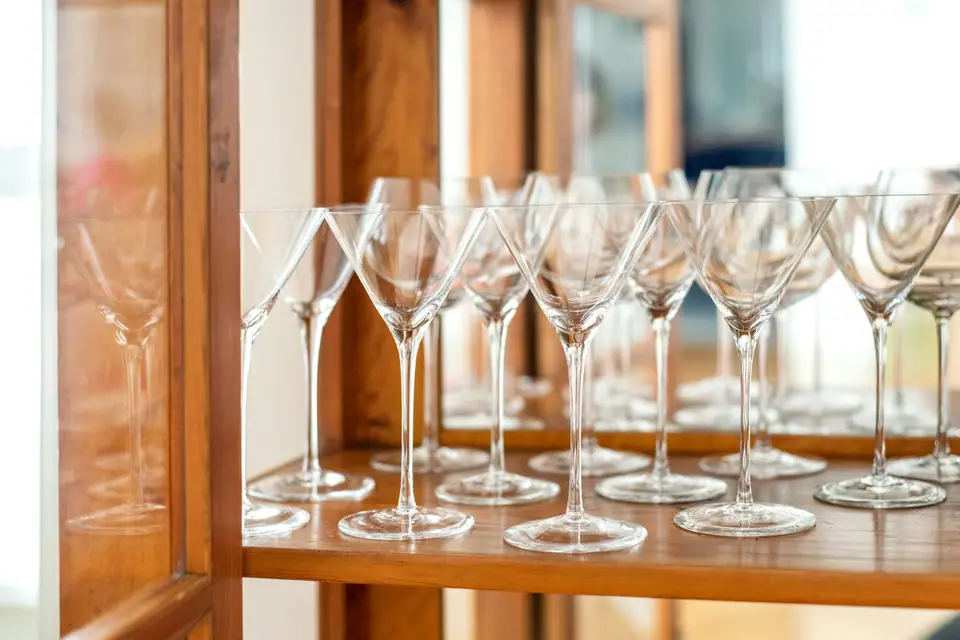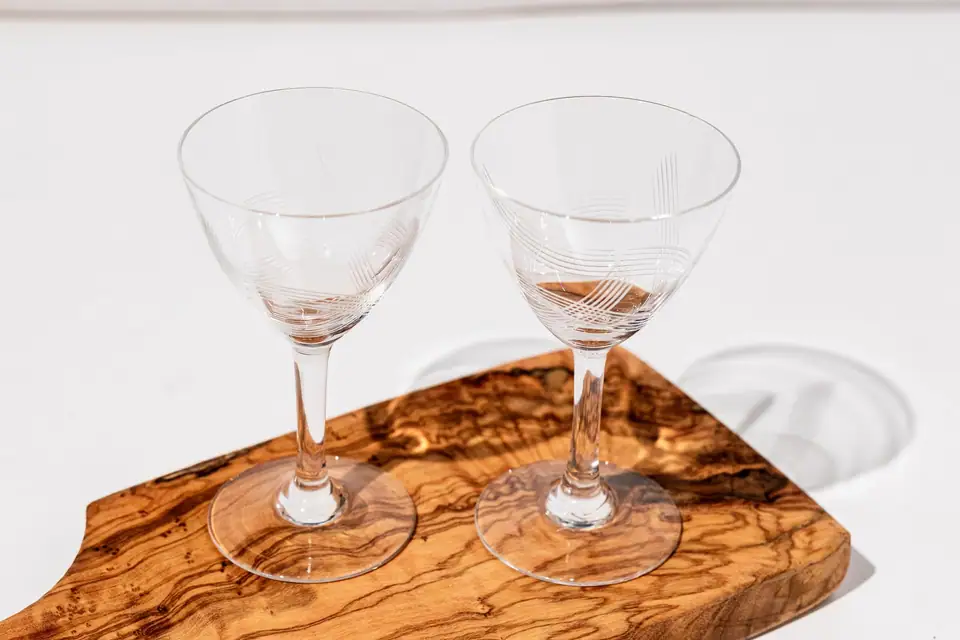
A Nick and Nora is a small stemmed glass with a tall, rounded bowl and a narrow mouth, holding about 5 oz. The shape dates from the 1930s; the name came in 1987, when bartender Dale DeGroff revived it for New York’s Rainbow Room. Judge a vintage one by shape and size, not its label.
This guide is part of our hub on vintage cocktail glasses.
Where did the Nick and Nora glass come from?
According to VinePair, DeGroff was hired in 1987 by the restaurateur Joe Baum to run the bar at the newly reopened Rainbow Room. Looking for something smaller than the oversized martini glasses of the time, he went through a 1930s catalog and found a small glass called the “Little Martini”. Food Republic names the glassware firm as Minners Designs, which revived the glass for him. Punch dates DeGroff’s revival to the same year and calls it a rebellion against the V-shaped martini glass that had come to dominate cocktail bars.
DeGroff named the glass after Nick and Nora Charles. The AFI Catalog records The Thin Man as a 1934 MGM film directed by W. S. Van Dyke, starring William Powell and Myrna Loy, based on Dashiell Hammett’s novel. The novel first ran in Redbook in December 1933 and came out as a book in 1934. Food Republic reports that the glass was later sold under the Nick and Nora name.
Vintage Nick and Nora glasses
Live listings, shown by eBay
Opens eBay in a new tab. Check condition, seller feedback and returns.
How is a Nick and Nora different from a coupe or a martini glass?
| Glass | Bowl | Typical size | Why people choose it |
|---|---|---|---|
| Nick and Nora | Tall, rounded, narrow mouth | About 5 oz (4 to 6 oz) | Smaller serve, hard to spill |
| Coupe | Wide and shallow | About 7 oz | Classic look for drinks served up |
| Martini (V-shaped) | Inverted cone, wide rim | Varies; Difford’s suggests no more than about 7 oz | The traditional martini silhouette |
Difford’s Guide calls Nick and Noras dainty stemmed glasses that date from the 1930s and tend to be smaller than the coupe. Tasting Table describes the shape as a cross between the coupe and the V-shaped glass, combining the roundness of one with the height of the other, and Punch puts it as curvier than a martini glass but deeper than a coupe.
The narrow mouth is the practical advantage. Cigar Aficionado notes that it is narrower than the wide rim of a V-shaped glass and that the straighter rim prevents the spills its conical rival is prone to. Punch adds that bartenders found the glasses hard to spill and hard to break.

If you already own coupes, a Nick and Nora is the glass for smaller serves. If you are starting a set, our vintage cocktail glasses hub explains which shapes cover most drinks, and the Vesper martini glass guide covers the deep champagne goblet.
Why did the Nick and Nora become so popular?
Size is most of the answer. VinePair reports that DeGroff wanted something smaller than the oversized martini glasses then in use, and Punch describes the glass as ideally suited to serious, stirred drinks. Cigar Aficionado adds that a smaller serve is finished before it warms, and the stem keeps a hand off the bowl.
The cocktail revival did the rest, and the glass is now sold new under the Nick and Nora name. That is why a listing title is not a date: a “Nick and Nora” glass may be new production, while a true 1930s piece of the same shape may be listed as a small cocktail or martini glass.
How do you find a vintage Nick and Nora?
- Search by shape. Look for small stemmed glasses with a tall, rounded bowl of about 4 to 6 oz, whatever the listing calls them.
- Check the size. Ask the seller for the height and capacity. A glass well over 6 oz is closer to a coupe or a goblet.
- Check the rim and stem. Thin vintage rims chip easily; run a finger around each one, and look for hairline cracks where the stem meets the bowl.
- Buy a set. Four or six matching glasses are easier to use than singles, and decoration such as etching or a gold band should match across the set.
Gold-banded and etched glasses need gentle washing by hand; our guide to caring for vintage glassware explains why. For more about decorated glass of the period, see mid-century barware designers.
Vintage coupes to pair with them
Live listings, shown by eBay
Opens eBay in a new tab. Check condition, seller feedback and returns.
Questions collectors ask
Why is it called a Nick and Nora glass?
After Nick and Nora Charles, the married detectives of Dashiell Hammett's The Thin Man and the 1934 film starring William Powell and Myrna Loy. Dale DeGroff gave the glass the name in 1987 when he revived it for the Rainbow Room in New York.
Is a Nick and Nora the same as a coupe?
No. Both are stemmed glasses for drinks served without ice, but the coupe has a wide, shallow bowl of about 7 oz, while the Nick and Nora is smaller, about 5 oz, with a taller bowl and a narrower mouth.
What did vintage catalogs call the Nick and Nora?
VinePair reports that DeGroff found the shape as the Little Martini in a 1930s catalog. Period glasses of the same form are rarely labeled Nick and Nora, so judge a vintage glass by its shape and size rather than its name.
What drinks go in a Nick and Nora glass?
Drinks served up, without ice. Punch describes the glass as suited to stirred, spirit-forward drinks, and it works just as well for a small non-alcoholic serve.
Sources
- How the Nick & Nora Became the Most Famous Glass of the Cocktail RevivalVinePair
- The Nick & Nora Is Out. These Trendy Cocktail Glasses Are In.Punch
- The Cinematic Origins Of The Nick & Nora Cocktail GlassFood Republic
- Cocktail Glassware Guide: Chilling, Types and SizesDifford's Guide
- The Three Types Of Martini Glasses, ExplainedTasting Table
- Nick & Nora GlassesCigar Aficionado
- The Thin Man (1934)AFI Catalog of Feature Films
- The Thin Man (novel by Hammett)Encyclopaedia Britannica
From our guide to Vintage Cocktail Glasses: Coupes, Nick and Nora, Martini and Rocks.